Your front door is the first thing people see when they arrive at your home. It’s also one of the hardest-working components on your house taking the brunt of weather exposure, temperature swings, and daily use, all while needing to keep your home secure and energy efficient.
Here’s the honest answer: choosing the perfect entry door isn’t just about picking something that looks good. It’s about balancing security, energy efficiency, durability, maintenance, and curb appeal all while staying within your budget. Get it wrong, and you could end up with a door that warps, rusts, or just doesn’t hold up to Arizona’s extreme heat.
In this guide, we’ll walk you through everything you need to know to choose the perfect entry door for your home from material comparisons and 2026 design trends to security features and cost considerations.
Table of Contents
Step 2: Consider 2026 Design Trends
Step 3: Prioritize Security Features
Step 4: Factor in Energy Efficiency
Real-World Conditions: The “If/Then” Guide
The Regrets Homeowners Mention Most
Key Takeaways / Quick Summary
- Entry doors cost $500–$2,500+ installed depending on material, size, and features
- Fiberglass offers the best overall balance of durability, energy efficiency, and low maintenance
- Steel is the most affordable and secure option but has a more utilitarian look
- Wood delivers unmatched natural beauty but requires the most maintenance
- Fiberglass doors can last 50+ years with minimal upkeep; steel lasts 25–40 years; wood lasts 15–25 years
- Smart locks, video doorbells, and keypad access are transforming entry door security in 2026
- Earthy neutrals, black, and deep greens are the top front door color trends for 2026
Step 1: Choose Your Material
The material you choose is the most important decision you’ll make. It affects everything—cost, durability, energy efficiency, maintenance, and appearance.
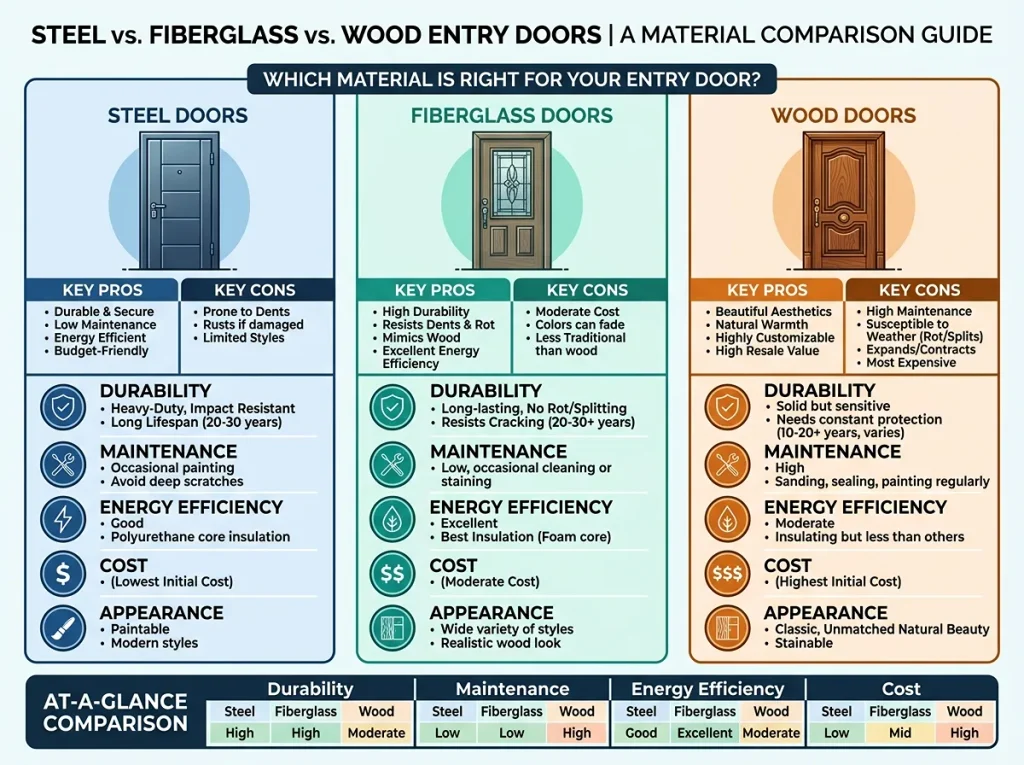
Steel Entry Doors
Steel doors are the most budget-friendly option upfront and offer some of the best security and durability available. They’re built around a steel skin over a rigid foam core, which gives them excellent insulation value along with serious strength.
Pros:
- ✓ Highest security and impact resistance
- ✓ Best energy efficiency per dollar
- ✓ Lowest upfront cost—typically $300–$800
- ✓ Low maintenance—no need to refinish or reseal
Cons:
- ✗ Can dent if struck hard enough
- ✗ Prone to rust over time if the finish is damaged
- ✗ Limited ability to mimic natural wood grain compared to fiberglass
Best for: Budget-conscious homeowners, side and back doors, and anyone prioritizing security over aesthetics.
Fiberglass Entry Doors
Fiberglass has become the go-to choice for homeowners who want the best of both worlds: the low maintenance of steel with the look of natural wood. Manufacturers have gotten remarkably good at replicating real wood grain texture, to the point where it’s hard to tell the difference up close.
Pros:
- ✓ Excellent durability—resists dents, warping, and rust
- ✓ Authentic wood-grain texture and staining options
- ✓ Strong energy efficiency with polyurethane foam cores delivering R-5 to R-6
- ✓ Handles temperature swings without warping
- ✓ With proper care, fiberglass doors can last 50 to 70 years
Cons:
- ✗ Higher upfront cost than steel—typically $600–$2,500
- ✗ Refinishing (if stained) requires some upkeep over time
Best for: Front entry doors where curb appeal matters and homeowners want a wood look without the maintenance burden.
Wood Entry Doors
Wood doors offer a classic, timeless look that steel and fiberglass can only approximate. For homeowners prioritizing authenticity and craftsmanship, nothing fully replaces real wood.
Pros:
- ✓ Unmatched natural beauty and customization
- ✓ Can be refinished and repaired rather than replaced
- ✓ Often the best choice for historic homes or specific architectural styles
Cons:
- ✗ Highest maintenance—needs regular refinishing to prevent warping, cracking, and water damage
- ✗ Most expensive option, especially for solid wood—typically $1,200–$3,500+
- ✗ More vulnerable to humidity and temperature swings
- ✗ Lower energy efficiency compared to insulated steel or fiberglass cores
Best for: Historic homes, luxury properties, and homeowners who value authentic craftsmanship and are willing to invest in maintenance.
Step 2: Consider 2026 Design Trends
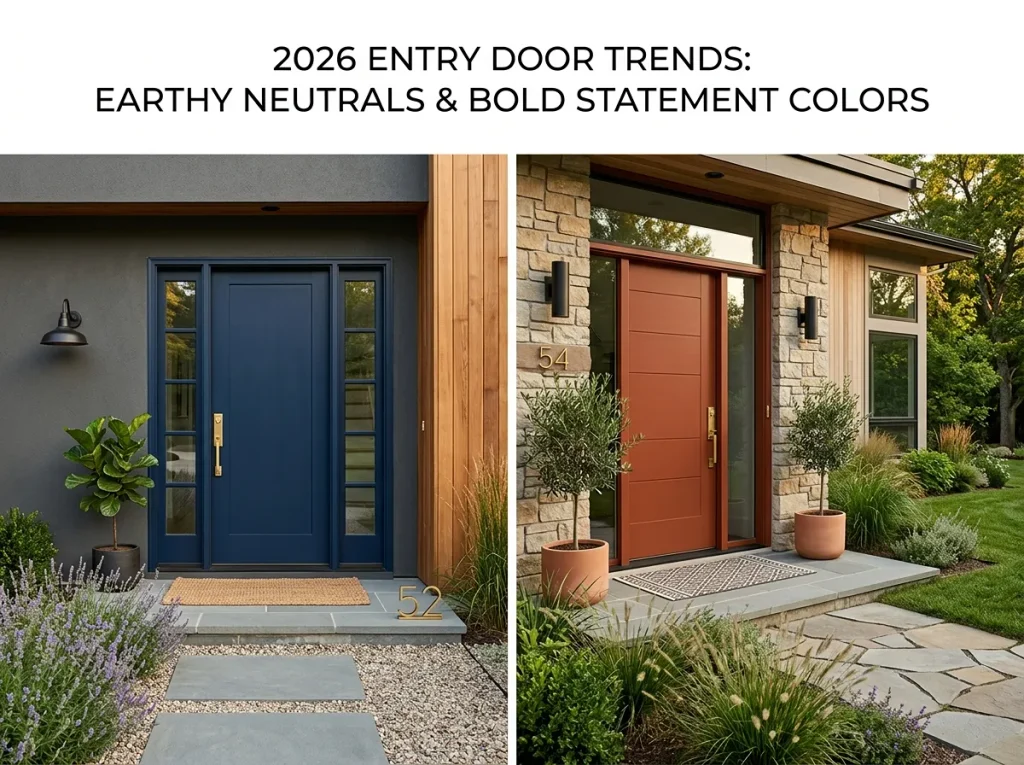
Your entry door is a statement piece. Here’s what’s trending in 2026:
Earthy Neutrals
Rich clay, soft brown, and textured whites are defining home design. Pantone’s 2026 Color of the Year, “Cloud Dancer,” a textured white, creates a sense of ease the moment you step inside.
Black is Back
A painted black door sits at the top of the list of most popular front door colors for 2026—it’s a perennial design choice that will never go out of style.
Deep Greens and Bold Accents
Deep forest shades, sapphire blue, topaz yellow, and ruby red are gaining popularity for homeowners who want their entry to make a statement.
Modern Minimalism
Clean lines, minimal articulation, and surfaces that speak through texture rather than ornament are shaping contemporary entry door design. Slim frames and expansive glass panels create bright, modern entries.
Matte Black Hardware
Matte black handles, hinges, and locks are the dominant hardware trend across modern door design in 2026.
Nature-Inspired Design
Calming design with earthy colors, organic textures, and biophilic elements that connect indoor and outdoor spaces is a major theme.
Step 3: Prioritize Security Features
Your entry door is your home’s first line of defense. Here’s what to look for:
Door Material Security
Steel offers the highest security and impact resistance. A reinforced steel door with a 4-1/8″ lock stile is the hardest to kick in.
Smart Lock Technology
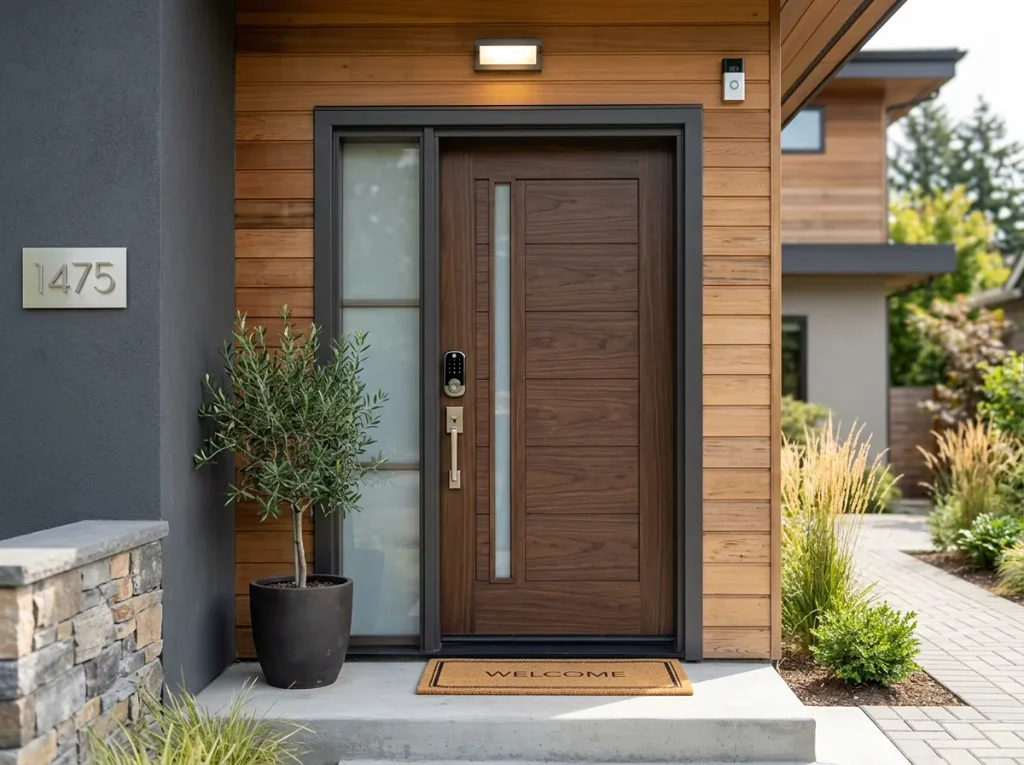
Smart locks with keypad, fingerprint, or phone access are transforming entry door security. Kwikset’s SmartKey Security technology protects against advanced break-in techniques and allows homeowners to re-key their locks in seconds. Biometric options like palm vein recognition and radar-based gesture unlocking are also emerging.
Video Doorbells and Smart Integration
Video doorbells, package cameras, and motion lighting are now standard considerations. Smart home integration allows communication between devices for seamless security.
Reinforced Frames and Quality Hardware
Don’t overlook the frame. A strong door is only as secure as its frame and hardware. Multi-point locking systems and commercial-grade hinges make a significant difference.
Step 4: Factor in Energy Efficiency
In Arizona’s extreme heat, energy efficiency isn’t optional—it’s essential.
Fiberglass Leads the Pack
Fiberglass doors with polyurethane foam cores deliver the best energy efficiency, with R-values of R-5 to R-6. This translates to lower cooling costs during Arizona’s brutal summers.
Steel is a Close Second
Steel doors with foam cores offer good energy efficiency, typically R-3 to R-5.
Wood Lags Behind
Wood doors have the lowest energy efficiency, relying on natural density rather than insulation cores.
Weatherstripping Matters
Proper weatherstripping around the door and threshold keeps out drafts, water, and insects—it’s a small cost that makes a big comfort difference.
Low-E Glass for Sidelights
If your door includes sidelights or glass panels, Low-E glass and proper shading are essential to reduce cooling costs. Solar Heat Gain Coefficient (SHGC) matters as much as U-value in hot climates.
Step 5: Understand the Costs
Here’s what you can expect to pay for an entry door in Arizona:
| Door Material | Material Cost | Installed Cost (Arizona) |
| Steel | $200 – $800 | $500 – $1,200 |
| Fiberglass | $500 – $2,500 | $700 – $2,500+ |
| Wood | $800 – $5,000+ | $1,200 – $5,000+ |
Sources: NailThePrice, Contractor+
Arizona-specific costs:
- In Phoenix, most homeowners pay around $1,200 for front door replacement
- In Chandler, costs typically range from $720 to $1,441
- In Tucson, the average is $469–$688
- Custom metal or high-end entry systems can cost $3,500–$12,000+
Cost factors:
- Sidelights and transoms add $300–$1,500 but create a grander entrance
- Smart lock integration adds $200–$500
- Custom sizes cost 50–100% more than standard 36″x80″ doors
- Labor typically accounts for 40% of the total cost
Real-World Conditions: The “If/Then” Guide
Here’s how to choose based on your specific situation:
If security is your top priority → Then choose a reinforced steel door with a 4-1/8″ lock stile and a high-quality deadbolt. Steel offers the highest impact resistance and security.
If you want the best overall value → Then choose fiberglass. It offers the best balance of durability, energy efficiency, low maintenance, and wood-like aesthetics.
If you’re on a tight budget → Then choose steel. It’s the most affordable option upfront and still delivers good security and energy efficiency.
If you have a historic or traditional home → Then choose wood. Nothing matches the authentic beauty and craftsmanship of real wood.
If you want minimal maintenance → Then choose fiberglass or steel. Both require very little upkeep compared to wood.
If you’re in Arizona’s extreme heat → Then choose fiberglass with a polyurethane foam core. It won’t warp in temperature swings and delivers the best energy efficiency.
If you want to make a design statement → Then choose a bold color (black, deep green, or sapphire blue) with matte black hardware. These are the top trends for 2026.
If you have an older home with a non-standard frame → Then expect higher costs and longer lead times. Custom sizing can add 50–100% to the door price.
The Regrets Homeowners Mention Most
After years of helping Arizona homeowners choose entry doors, here are the most common regrets:
Mistake 1: Choosing the cheapest option without considering long-term costs
A budget steel door might save you money upfront, but if it rusts or dents within a few years, you’ll be replacing it sooner than you’d like. Fiberglass costs more initially but lasts significantly longer with minimal maintenance.
Mistake 2: Ignoring energy efficiency in Arizona’s heat
Many homeowners focus on looks and forget about insulation. In Arizona’s extreme heat, a poorly insulated door can drive up your cooling costs significantly. Fiberglass with a polyurethane foam core is your best bet.
Mistake 3: Not considering the frame and installation quality
A beautiful door is only as good as its frame and installation. Poor installation leads to air leaks, water damage, and security vulnerabilities. Choose a professional installer who understands the importance of proper weatherstripping and sealing.
Mistake 4: Forgetting about hardware and smart features
Smart locks, video doorbells, and quality hardware are often afterthoughts. Plan for these early to ensure your door is prepped for the technology you want.
Mistake 5: Overlooking the impact of sunlight
In Arizona, intense sun can fade and damage doors over time. Choose materials and finishes that are UV-resistant, and consider an overhang or porch for additional protection.
Frequently Asked Questions
What is the best material for an entry door?
Fiberglass is the best overall choice for most homeowners. It offers excellent durability, energy efficiency, low maintenance, and can mimic the look of real wood. Steel is best for security and budget. Wood is best for authentic beauty and historic homes.
How much does a new entry door cost in Arizona?
In Arizona, entry door replacement typically costs $500–$2,500+ installed. In Phoenix, most homeowners pay around $1,200. In Chandler, costs range from $720 to $1,441.
Which entry door material is most energy efficient?
Fiberglass with a polyurethane foam core is the most energy efficient, delivering R-5 to R-6. Steel with a foam core is a close second at R-3 to R-5. Wood is the least efficient.
What entry door colors are trending in 2026?
Earthy neutrals (clay, soft brown, textured white), black, deep forest green, sapphire blue, and bold statement colors like topaz yellow and ruby red are all trending for 2026.
How long do entry doors last?
Fiberglass doors can last 50 to 70 years with proper care. Steel doors typically last 25–40 years. Wood doors last 15–25 years without regular maintenance.
What security features should I look for in an entry door?
Look for steel construction for maximum impact resistance, smart locks with keypad or biometric access, multi-point locking systems, reinforced frames, and quality deadbolts. Kwikset’s SmartKey technology allows you to re-key locks in seconds.
Do I need a permit to replace my front door in Arizona?
Generally no. Front door replacement in Phoenix typically does not require a permit for standard installations. Check with your local building department if your project involves structural changes.
Can I install an entry door myself?
Handy homeowners with basic tools can handle straightforward entry door replacement. However, if your project involves structural modifications or complex framing, hire a licensed professional. DIY can save $336–$432 in labor.
What are sidelights and transoms?
Sidelights are narrow windows on one or both sides of the door that let in natural light. Transoms are windows above the door. They add $300–$1,500 to the cost but create a grander, more inviting entrance.
Should I match my entry door to my home’s architectural style?
Yes. Your entry door should complement your home’s style. Traditional homes often suit wood or six-panel doors. Modern homes look great with sleek fiberglass doors and slim frames. Historic homes benefit from authentic wood craftsmanship.
Why Choose Windowz4Less Arizona?
Choosing the perfect entry door is a big decision. The right choice depends on your home’s architecture, your budget, your priorities, and how you use your space.
Windowz4Less Arizona is here to help you make the right choice.
- Local expertise — We know Arizona’s unique climate and recommend doors that perform in extreme heat
- Quality products — We offer a range of entry doors in steel, fiberglass, and wood from leading manufacturers
- Professional installation — Our team is trained, insured, and follows industry best practices
- Transparent pricing — No hidden fees, no surprises
- Free estimates — No-obligation quotes with honest, straightforward advice
- Serving Mesa, Phoenix, and surrounding areas — We’re your local experts
Whether you’re exploring entry door styles, prioritizing entry door security, or comparing entry door materials, we’re here to help you find the perfect door for your home.
Your Next Step: Find the Perfect Entry Door for Your Home
Your entry door is more than just a door—it’s the first impression of your home, a critical security barrier, and a key factor in your home’s energy efficiency. The right choice balances all of these priorities while reflecting your personal style.
Contact Windowz4Less Arizona today for a free, no-obligation estimate. We’ll help you explore your options and find the perfect entry door for your Arizona home.