Your front door is the first thing guests see. But more importantly, it’s the first line of defense for your home and family.
Here’s the thing most homeowners don’t realize: a beautiful door isn’t necessarily a secure door. In fact, some of the most common entry doors—including standard wood and basic hollow-core steel doors—can be surprisingly easy to break into. A determined intruder can kick in a poorly secured door in seconds.
But the good news is that modern entry doors offer more security features than ever before. From multi-point locking systems to smart locks and reinforced frames, you can dramatically improve your home’s security without sacrificing style.
In this guide, we’ll walk you through the most important entry door security features to look for—and help you choose a door that protects your home and looks great doing it.
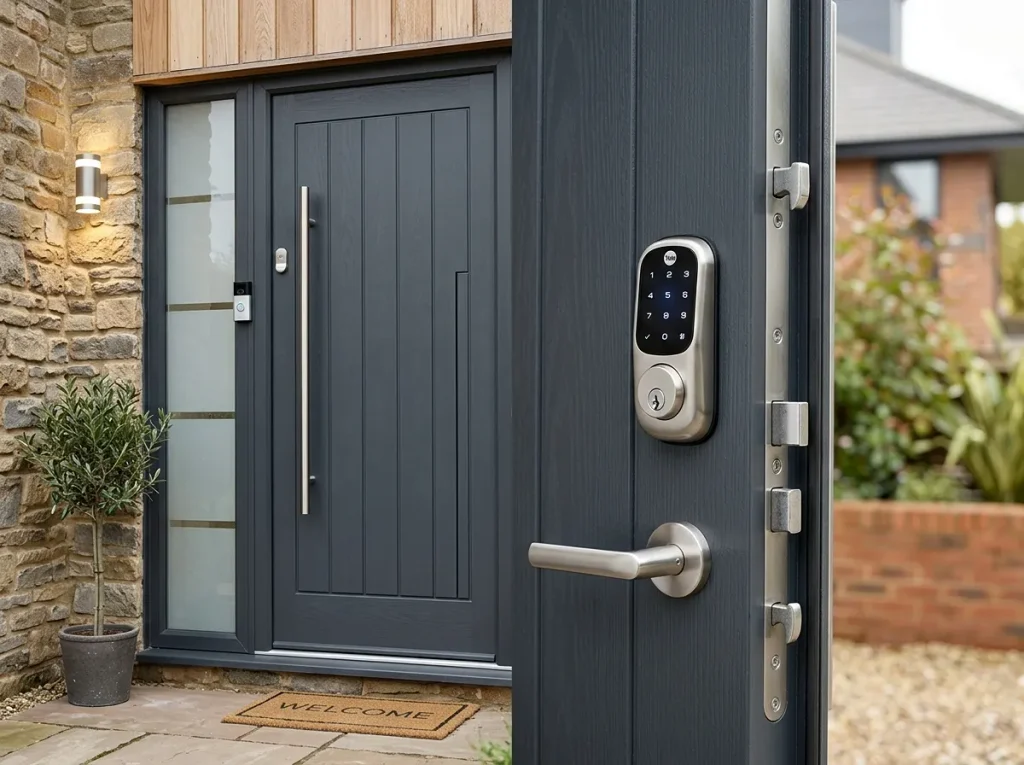
Table of Contents
What Makes an Entry Door Secure?
Feature #1: Door Material and Construction
Feature #3: Frame and Strike Plate Security
Feature #4: Hinges and Hardware
Feature #5: Glass and Sidelight Security
Feature #6: Smart Technology and Integration
Real-World Conditions: The “If/Then” Guide
The Regrets Homeowners Mention Most
Key Takeaways / Quick Summary
- A standard door with a basic lock can be kicked in in under 30 seconds—reinforced doors take significantly longer
- Steel doors offer the highest impact resistance and are the hardest to break through
- Multi-point locking systems secure the door at 3+ points, making forced entry extremely difficult
- Smart locks with keypad, fingerprint, or phone access are transforming entry door security in 2026
- The frame is often the weakest point—reinforced frames and strike plates are essential
- Solid-core doors are significantly more secure than hollow-core doors
- Video doorbells and smart home integration add layers of security and convenience
- Professional installation is critical—even the best door can be compromised by poor installation
What Makes an Entry Door Secure?
Before we dive into specific features, let’s talk about what actually makes a door secure. It comes down to four key factors:
- Door material and construction — How strong is the door itself?
- Locking system — How many points secure the door, and how robust are they?
- Frame and installation — Is the frame reinforced, and was the door installed properly?
- Additional technology — Smart locks, video doorbells, and alarms add layers of protection
A truly secure entry door combines all four. Weakness in any one area can compromise the entire system.
Feature #1: Door Material and Construction
The material and construction of your door determine how much punishment it can take. Here’s how the options compare:
| Door Material | Security Rating | Impact Resistance | Best For |
| Steel | Highest | Excellent | Maximum security |
| Fiberglass | High | Very Good | Security + aesthetics |
| Solid Wood | Moderate | Good | Traditional homes |
| Hollow-Core | Low | Poor | Interior doors only |
Steel: The Security Standard
Steel doors offer the highest level of security available. They’re built around a steel skin over a rigid foam core, creating a barrier that’s extremely difficult to breach. A reinforced steel door with a 4-1/8″ lock stile is the hardest to kick in.
Why it matters: Most break-ins happen through forced entry at the door. A steel door can withstand repeated impacts that would splinter wood or dent fiberglass.
Best for: Homeowners who prioritize security above all else.
Fiberglass: Strong and Beautiful
Fiberglass doors are a close second in security. They resist dents, warping, and cracking—and they can mimic the look of real wood without the vulnerability.
Why it matters: Fiberglass won’t rot, warp, or crack like wood, which means it maintains its security integrity over time. Many high-quality fiberglass doors have solid cores that add to their strength.
Best for: Homeowners who want security without sacrificing curb appeal.
Solid Wood: Beautiful but Vulnerable
Wood doors offer unmatched beauty, but they’re more vulnerable to forced entry than steel or fiberglass. A solid wood door is significantly better than a hollow-core door, but it can still be splintered or kicked in with enough force.
Why it matters: Wood also requires more maintenance. If it warps or cracks, its security is compromised.
Best for: Historic homes and homeowners willing to invest in additional security measures.
Hollow-Core: Avoid for Exterior Use
Hollow-core doors are exactly what they sound like—mostly empty space inside. They’re lightweight, affordable, and completely unsuitable for exterior entry doors. A hollow-core door can be broken through with a single kick.
Why it matters: If your entry door is hollow-core, replacing it should be your top security priority.
Best for: Interior closet doors only.
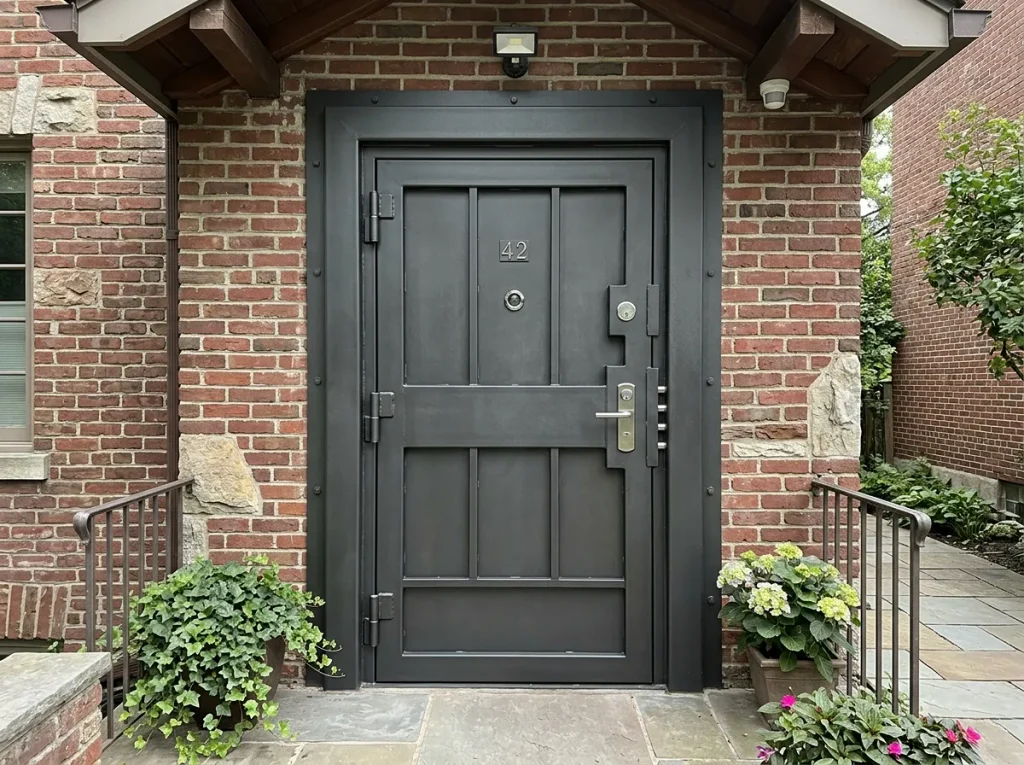
Feature #2: Locking Systems
Your locking system is the heart of your door’s security. Here’s what to look for:
Multi-Point Locking Systems
Multi-point locking systems secure the door at three or more points—typically the top, middle, and bottom of the door. When you turn the key or handle, bolts extend into the frame at multiple locations.
Why it matters: A door with a single lock can be forced open at the corners or bottom. Multi-point systems make this nearly impossible. They’re standard on high-security doors and increasingly common on residential entry doors.
What to look for: At least three locking points. Some premium systems offer 5 or more.
Deadbolts
A quality deadbolt is essential. Look for:
- Grade 1 or Grade 2 deadbolt — these are the highest residential security ratings
- 1-inch throw — the bolt should extend at least 1 inch into the frame
- Solid steel construction — not hollow or pot metal
- Anti-pick and anti-bump technology — prevents common lock-picking techniques
Why it matters: A cheap deadbolt can be picked, bumped, or snapped. A quality deadbolt can withstand these attacks.
Smart Locks
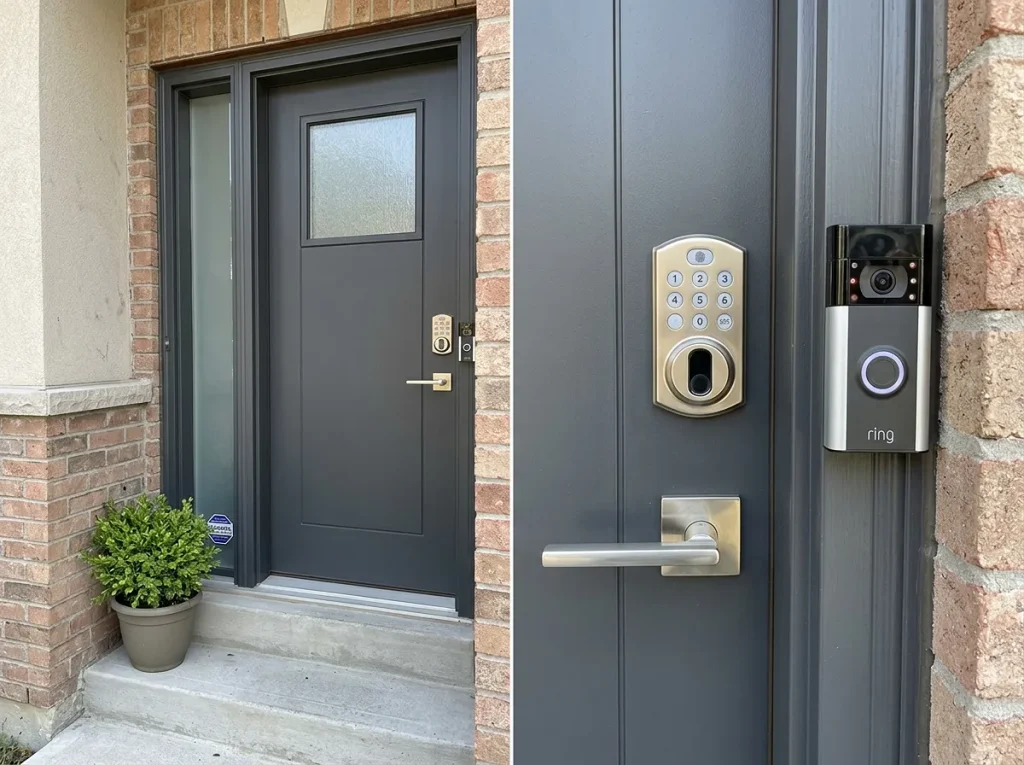
Smart locks are transforming entry door security. They offer:
- Keypad entry — no more hidden keys
- Fingerprint or biometric access — the ultimate convenience and security
- Phone app control — lock and unlock from anywhere
- Access codes for guests — grant temporary access to contractors, dog walkers, or family
- Audit trails — see who entered and when
Why it matters: Smart locks eliminate the vulnerability of hidden keys and let you control access remotely. Kwikset’s SmartKey Security technology protects against advanced break-in techniques and allows homeowners to re-key their locks in seconds.
What to look for: ANSI/BHMA Grade 1 or Grade 2 certification, encrypted communication, and backup power options.
Feature #3: Frame and Strike Plate Security
Here’s something most homeowners don’t realize: the frame is often the weakest point of a door system.
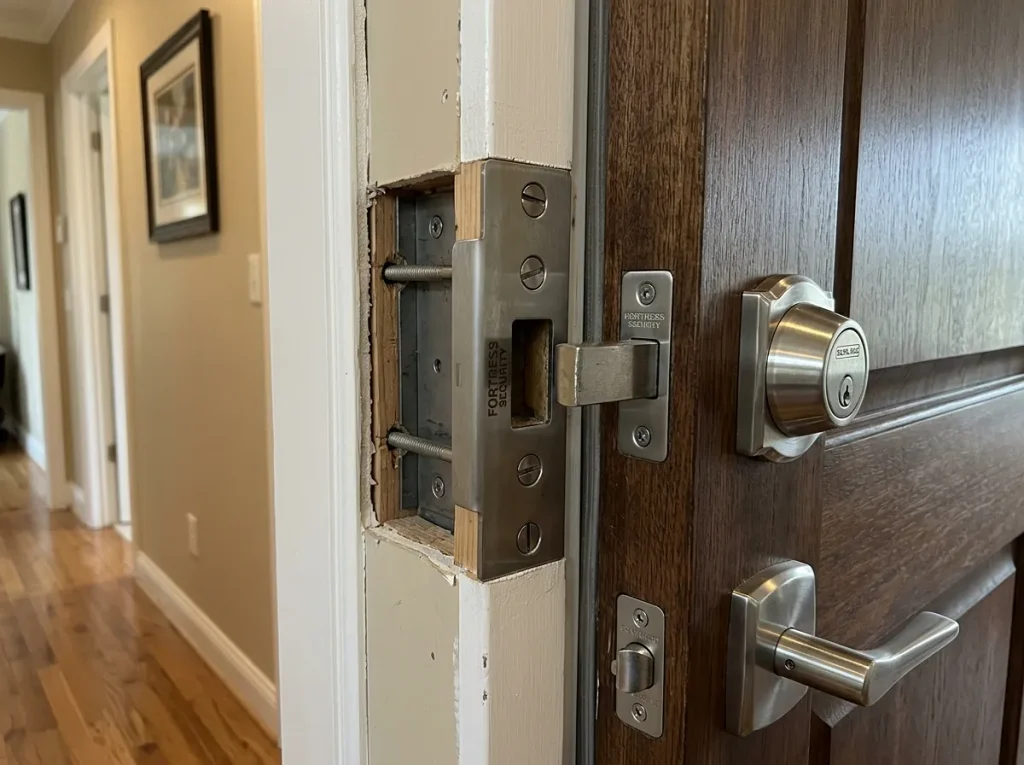
When someone kicks a door, the force is concentrated on the frame and strike plate—not the door itself. If the frame is soft wood or the strike plate is secured with short screws, the door can be forced open even if the door itself is strong.
Reinforced Frames
What to look for:
- Solid wood or metal frame — not hollow or soft wood
- Reinforced strike plate — with longer screws that anchor into the studs
- Security strike plates — larger plates that distribute force over a wider area
- Frame reinforcement kits — available for retrofitting existing doors
Why it matters: A reinforced frame can make the difference between a door that holds and one that gives way.
Strike Plates
The strike plate is the metal plate on the door frame where the deadbolt enters. Cheap strike plates are secured with short screws that can be ripped out easily.
What to look for:
- Heavy-duty strike plate — at least 16-gauge steel
- 3-inch screws — long enough to reach the structural studs behind the frame
- Box strike — encloses the bolt for added security
Why it matters: Upgrading to a reinforced strike plate with 3-inch screws is one of the cheapest, most effective security upgrades you can make.
Feature #4: Hinges and Hardware
Don’t overlook the hinges. A door is only as secure as its weakest component.
Security Hinges
What to look for:
- Nylon or stainless steel hinges — resist wear and tampering
- Non-removable pins — prevent hinges from being popped out
- Security studs — interlock the door and frame when closed
Why it matters: Standard hinges can be removed from the outside, allowing an intruder to lift the door out of the frame. Security hinges prevent this.
Door Viewers and Chains
For added security, consider:
- Peephole or door viewer — see who’s at the door without opening it
- Door chain or limiter — allows you to open the door partially while keeping it secure
- Reinforced door edge — metal plates that prevent the door from being pried open
Feature #5: Glass and Sidelight Security
Glass panels, sidelights, and transoms add beauty to an entry door—but they can also be a security vulnerability.
What to look for:
- Impact-resistant or laminated glass — much harder to break than standard glass
- Decorative or frosted glass — obscures the view inside while still letting light through
- Security film — can be applied to existing glass to make it harder to shatter
- Reinforced frames around glass — prevents the glass from being easily removed
Why it matters: An intruder can break a glass panel and reach inside to unlock the door. Impact-resistant glass makes this much more difficult.
Arizona tip: Low-E glass is also important for energy efficiency, but make sure it’s paired with impact resistance for security.
Feature #6: Smart Technology and Integration
In 2026, entry door security is increasingly about smart technology.
Video Doorbells
Video doorbells let you see and communicate with anyone at your door—from anywhere. They record footage of activity, which can be used as evidence if a crime occurs.
What to look for:
- HD video quality
- Night vision
- Two-way audio
- Motion detection alerts
- Cloud or local storage
Smart Home Integration
Your entry door security can integrate with your broader smart home system:
- Alarms — door sensors trigger alarms when opened unexpectedly
- Lighting — smart lights flash or turn on when someone approaches
- Cameras — entry cameras work with other security cameras
- Automation — lock doors automatically at night
Why it matters: Integration creates layers of security. Even if one system fails, others provide backup.
Real-World Conditions: The “If/Then” Guide
Here’s how to choose the right security features based on your specific situation:
If you’re on a tight budget → Then start with the essentials: a reinforced strike plate with 3-inch screws ($20–$50) and a quality deadbolt ($50–$150). These upgrades alone significantly improve security.
If you want maximum security → Then choose a steel door with a multi-point locking system, reinforced frame, and security hinges. Add a smart lock and video doorbell for complete coverage.
If you’re concerned about break-ins in your neighborhood → Then prioritize door material and frame reinforcement. Steel or fiberglass doors with multi-point locking are the hardest to breach.
If you want convenience and security → Then choose a smart lock with keypad or fingerprint access plus a video doorbell. You get keyless entry and can monitor your door from anywhere.
If you have glass panels or sidelights → Then upgrade to impact-resistant or laminated glass. This prevents intruders from breaking glass to reach inside.
If you have a historic home → Then choose a solid wood door with reinforced frame and upgraded hardware. You can maintain the historic look while improving security.
If you’re installing a new door → Then consider steel or fiberglass for the best security. If you want the look of wood without the vulnerability, choose a steel security door that mimics wood grain.
If you’re comparing security door options → Then learn the difference between security doors vs security screen doors to choose the right product for your needs.
The Regrets Homeowners Mention Most
After helping thousands of homeowners improve their entry door security, here are the most common regrets:
Mistake 1: Assuming the door itself is the only thing that matters
A strong door with a weak frame and strike plate is like a vault with a cardboard door. The frame and hardware are just as important as the door material.
Mistake 2: Choosing the cheapest lock
A $20 deadbolt from a big-box store isn’t the same as a Grade 1 security deadbolt. Cheap locks can be picked, bumped, or snapped in seconds.
Mistake 3: Ignoring the frame
Most break-ins happen at the frame, not the door. Reinforcing the frame with longer screws and a heavy-duty strike plate is one of the cheapest, most effective security upgrades you can make.
Mistake 4: Skipping impact-resistant glass
Glass panels and sidelights are beautiful, but standard glass breaks easily. Impact-resistant glass is a small upgrade that makes a big difference.
Mistake 5: Not hiring a professional
A beautiful, secure door installed poorly will leak, stick, and fail. Professional installation ensures your door performs as designed and maintains its security integrity.
Frequently Asked Questions
What is the most secure type of entry door?
Steel doors offer the highest security. They’re the hardest to kick in and provide the best impact resistance. Fiberglass is a close second and offers more design flexibility.
What is a multi-point locking system?
A multi-point locking system secures the door at three or more points—typically top, middle, and bottom. When you lock the door, bolts extend into the frame at multiple locations, making forced entry extremely difficult.
Are smart locks secure?
Yes—quality smart locks are very secure. Look for ANSI/BHMA Grade 1 or Grade 2 certification, encrypted communication, and backup power options. They eliminate the vulnerability of hidden keys.
What’s the weakest point of an entry door?
The frame and strike plate are often the weakest points. Even a strong door can be kicked in if the frame is soft or the strike plate is secured with short screws. Reinforcing the frame is essential.
How can I make my existing door more secure?
Start with these upgrades:
- Replace short strike plate screws with 3-inch screws
- Install a heavy-duty strike plate
- Add a quality deadbolt (Grade 1 or 2)
- Add a smart lock or video doorbell
- Install security hinges with non-removable pins
What is the difference between a security door and a security screen door?
A security door is a heavy-duty door (often steel) designed for maximum protection. A security screen door provides ventilation and visibility while adding a layer of security. Learn more in our guide on security door vs security screen door.
How much does it cost to upgrade entry door security?
Costs vary:
- Reinforced strike plate with 3-inch screws: $20–$50
- Quality deadbolt: $50–$150
- Smart lock: $200–$500
- Video doorbell: $150–$300
- New steel or fiberglass door: $500–$2,500+
Do I need a professional to install a security door?
Yes. Professional installation ensures proper fit, alignment, and security. A poorly installed door can leave gaps that compromise both security and energy efficiency.
What is a steel security door?
A steel security door is a heavy-duty door made from steel, designed to provide maximum protection against forced entry. They’re available in a range of styles, including designs that mimic wood. Learn more about the steel security door benefits.
Are impact-resistant glass panels worth it for entry doors?
Yes. Impact-resistant or laminated glass is much harder to break than standard glass. It prevents intruders from breaking glass to reach inside and unlock the door.
Why Choose Windowz4Less Arizona?
Windowz4Less Arizona understands that entry door security is about more than just a lock. It’s about the entire system—door, frame, hardware, and technology working together.
- Local expertise — We know Arizona’s climate and recommend doors that perform in extreme heat
- Quality products — We offer steel, fiberglass, and wood entry doors with advanced security features
- Professional installation — Our team is trained, insured, and follows industry best practices for security and performance
- Transparent pricing — No hidden fees, no surprises
- Free estimates — No-obligation quotes with honest, straightforward advice
- Serving Mesa, Phoenix, and surrounding areas — We’re your local experts
Whether you’re exploring entry door security options or ready to install, we’re here to help you protect your home.
Your Next Step: Secure Your Home Today
Your entry door is your home’s first line of defense. Don’t leave it to chance. Whether you need a new door with advanced security features, upgraded locks, or professional installation, the right partner makes all the difference.
Contact Windowz4Less Arizona today for a free, no-obligation estimate. We’ll help you choose the right entry door security features for your home and budget—and provide professional installation you can trust.