Most doors marketed as “high-security” share a similar look: heavy, dark, maybe some decorative ironwork. From the curb, they all seem to promise the same thing.
Here’s what most homeowners don’t discover until after they’ve bought one: the look tells you almost nothing about the actual protection. Two doors can appear identical and perform completely differently under force because the difference lives in the specifications, not the surface.
A genuinely high-security door is defined by a small set of engineering features. Get those right, and you have a barrier that resists forced entry. Miss any one of them, and you have a heavy door that looks reassuring and fails when it counts.
This guide covers the five features that actually matter and the specifications to check for each. If you’re in the Phoenix metro area and want local help evaluating options, Windowz4Less Arizona works with homeowners across the Valley.
Key Takeaways / Quick Summary
- Steel gauge determines the door’s resistance to cutting and prying look for 12- or 14-gauge panel steel and 16-gauge or thicker frame steel
- Anchoring into structural framing is the single most important installation feature stucco alone provides almost no holding power
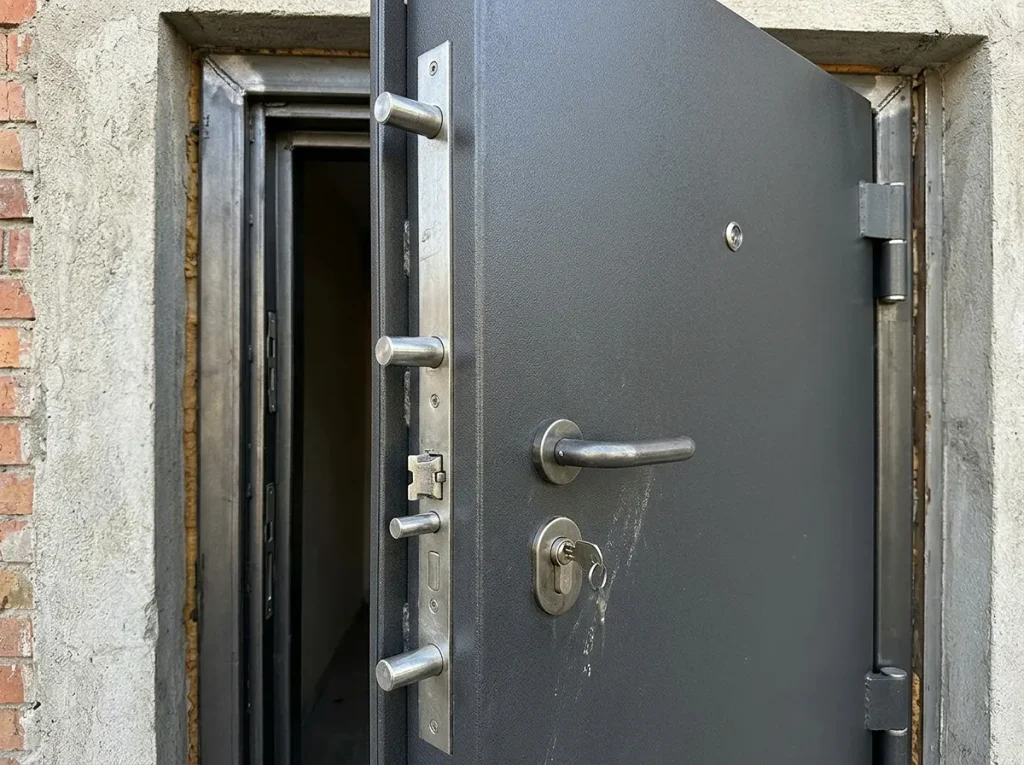
- Multi-point locking systems engage at three or more points and dramatically outclass single-latch designs
- Impact-resistant or laminated glass is essential if the door has glass panels standard annealed glass breaks easily
- Security hinges with non-removable pins prevent the door from being lifted out of its frame
- High-security doors typically cost 400–2,000+ installed, depending on material, hardware, and design
- Professional installation protects both performance and warranty coverage
Feature #1: Adequate Steel Gauge
Gauge is the foundation. Everything else locks, hinges, frames depends on the door panel itself being strong enough to resist physical attack.
What gauge actually means: Lower numbers equal thicker steel. A 12-gauge panel is substantially thicker and stronger than 18-gauge.
What to look for:
- Door panel: 12- or 14-gauge steel
- Frame: 16-gauge or thicker
- Reinforced corners: welded or mechanically reinforced, not just folded metal
Why it matters: Thin steel can be cut with common tools and pried with a crowbar. Thicker steel resists both and buys time which is the entire point of a physical barrier.
What to ask: “What gauge is the door panel and what gauge is the frame?” If the answer isn’t specific, that’s a warning sign. If the spec sheet doesn’t list gauge, ask for it in writing.
Feature #2: Frame Construction and Anchoring
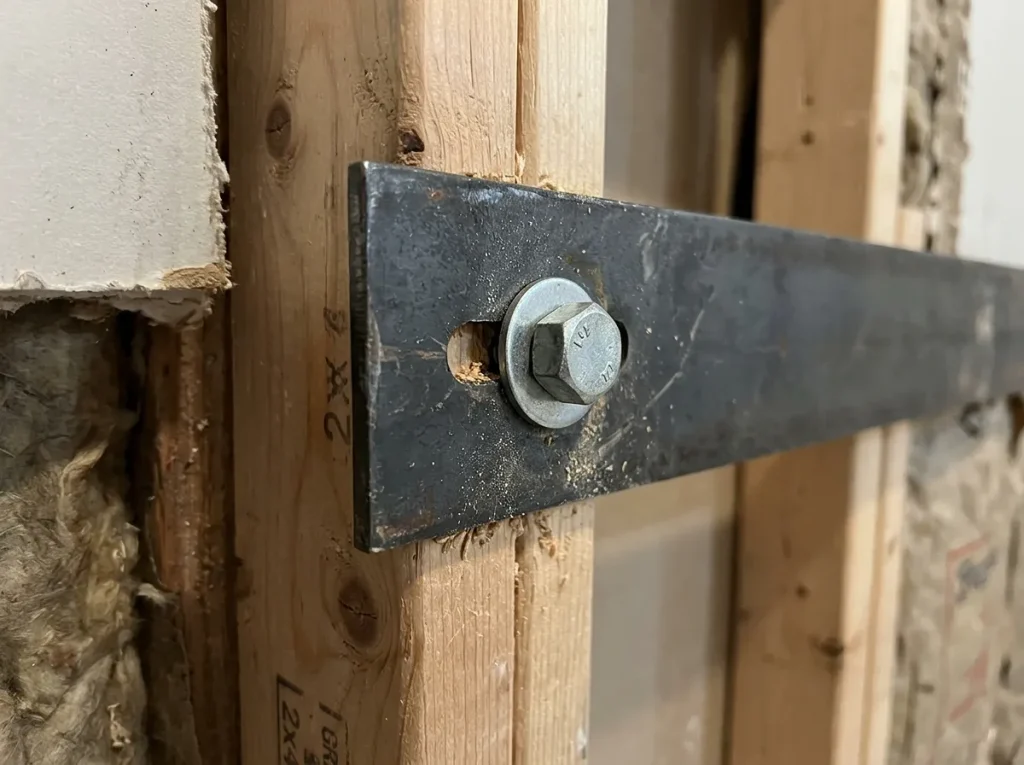
This is the most overlooked feature on the list, and in practice it’s the one that most often determines whether a door holds.
Why the frame matters so much: A security door is only as strong as the connection between the door and the wall. When someone forces a door, the load transfers to the frame and the anchors. If those anchors are set into stucco, drywall, or sheathing, they pull out often taking a chunk of the wall with them. The whole door-and-frame unit can be pried out as one piece, without the lock ever being defeated.
What to look for:
- Reinforced frame made of steel or heavy-gauge material
- Multiple anchor points along both sides and the top of the frame
- Fasteners long enough to reach structural framing typically studs or header material
- Proper flashing around the frame to prevent water intrusion
Arizona-specific: Stucco exteriors require cutting back the stucco to expose the framing behind it. This is a specific skill. Installers who propose anchoring directly into the stucco surface are skipping the step that makes the door work.
What to ask: “How many anchor points will this installation have, and what will the fasteners go into?”
Feature #3: Multi-Point Locking System
Locks are where the marketing is loudest and the specifications matter most.
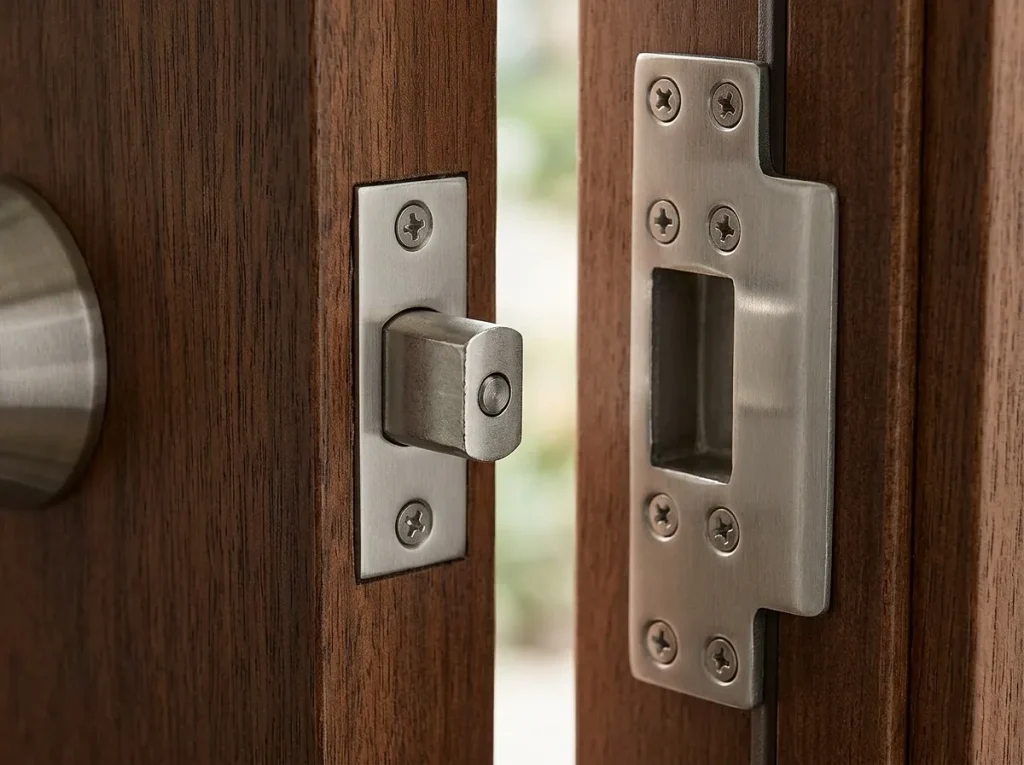
Why single latches fail: A standard door latch engages at one point, usually a shallow hook or lever. It can be popped with a shove, a flat tool, or a well-placed kick. Even a strong door with a weak latch is a soft target.
What to look for:
- Multi-point locking engaging at three or more points typically top, middle, and bottom
- Deadbolts rated Grade 1 or Grade 2 by the Builders Hardware Manufacturers Association (BHMA)
- One-inch deadbolt throw into the frame or strike
- Reinforced strike plates secured with long screws into structural framing
- Anti-pick and anti-bump features on the cylinder
Why it matters: Multi-point locking distributes force across the entire door edge. To defeat it, an intruder has to overcome several points simultaneously, which is dramatically harder and much louder.
What to ask: “How many locking points does this door have, and what grade are the deadbolts?”
Feature #4: Impact-Resistant or Laminated Glass
If the door has any glass a panel, a decorative insert, sidelights this feature matters enormously.
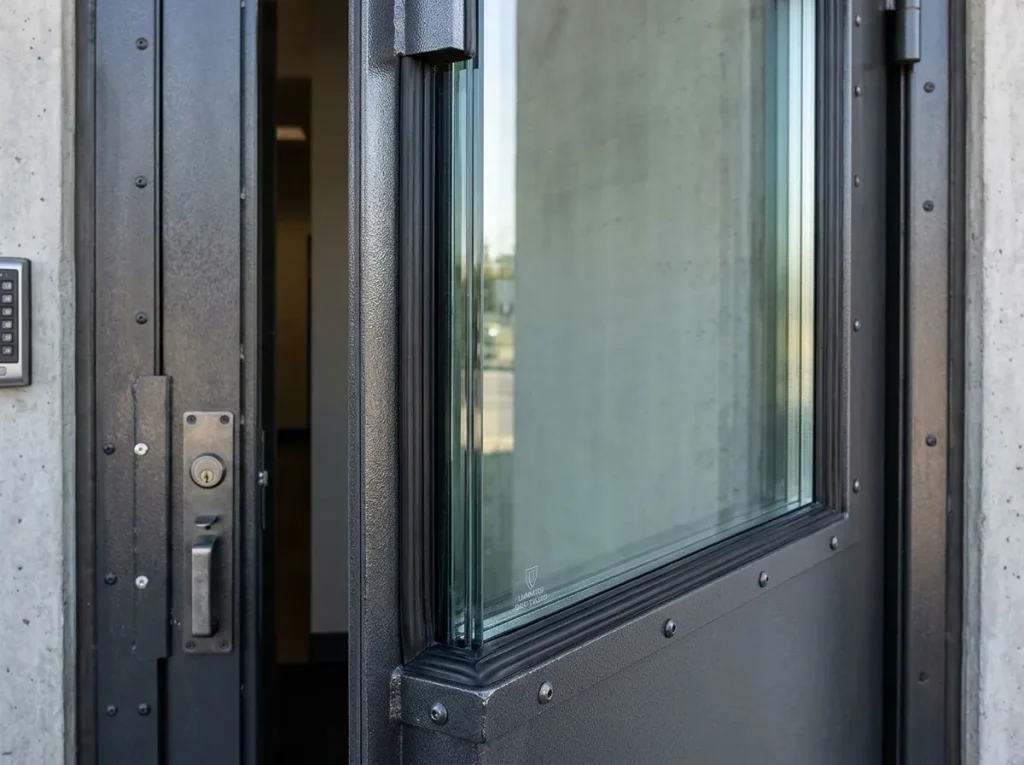
Why standard glass is a vulnerability: Standard annealed glass shatters into large shards on impact. Once broken, an intruder can reach through and operate the interior lock or simply step through. It’s the fastest way to bypass an otherwise strong door.
What to look for:
- Laminated glass two panes bonded to a plastic interlayer that holds the glass together after impact
- Impact-resistant glass engineered to a higher standard
- Decorative or frosted options that provide privacy without sacrificing strength
- Security film as a lower-cost retrofit if replacement isn’t feasible
Why it matters: Laminated glass may crack, but it stays in the frame. That turns a quick break-and-reach into a sustained, noisy effort which is exactly what deters opportunistic intruders.
If your door has no glass at all → Then this feature doesn’t apply, and the solid panel becomes the barrier. But if you’re comparing a glass-panel door to a solid one, make sure you’re comparing like security levels.
Related note: If you’re also securing swinging entry doors with glass, our guide to entry door security features covers the same principle across door types.
Feature #5: Security Hinges and Hardware
Hinges are the quiet failure point. Most homeowners never think about them until they learn how easily a standard hinge can be defeated.
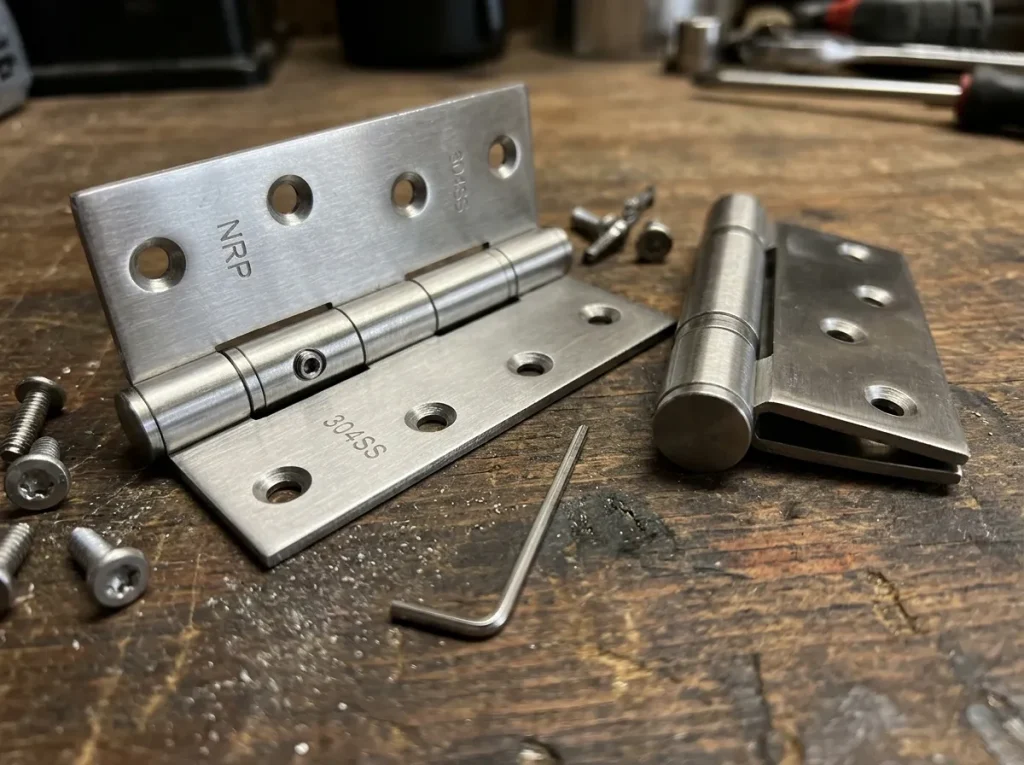
Why standard hinges are a risk: On an outswing door, hinges are exposed to the exterior. Standard hinges with removable pins can be popped out, allowing the door to be lifted off its hinges entirely no lock picking required.
What to look for:
- Non-removable hinge pins (also called fixed pins or security pins)
- Security studs that interlock the door and frame when closed
- Heavy-duty hinges rated for the door’s weight
- Through-bolted handles and hardware rather than surface-screwed fittings
- Reinforced strike plates with fasteners into framing
Why it matters: Hinges and hardware are the mechanical connection between the door and the frame. If they can be removed or defeated, the door’s steel gauge and locking system never come into play.
What to ask: “Are the hinge pins non-removable, and is the hardware through-bolted?”
The Five Features at a Glance
| Feature | What to Look For | Why It Matters |
| 1. Steel Gauge | 12–14 gauge panel, 16+ gauge frame | Resists cutting and prying |
| 2. Frame & Anchoring | Reinforced frame, multiple anchors into structural framing | Prevents the unit being pried out of the wall |
| 3. Locking System | Multi-point (3+ points), Grade 1 or 2 deadbolts | Prevents latch defeat and distributes force |
| 4. Glass | Laminated or impact-resistant | Prevents break-and-reach entry |
| 5. Hinges & Hardware | Non-removable pins, security studs, through-bolted | Prevents hinge removal and hardware defeat |
Real-World Conditions: The “If/Then” Guide
If you’re on a tight budget → Then prioritize steel gauge and the locking system above decorative finishes. A 14-gauge door with a multi-point lock and professional installation protects you far better than a thin decorative door.
If you have a stucco home → Then confirm your installer will anchor into structural framing, not just the stucco surface. This is the most common failure point in Arizona.
If the door has glass panels → Then upgrade to laminated or impact-resistant glass. Standard glass undermines everything else.
If you have a rear or side entry → Then prioritize features 1, 2, and 3 the door is less visible, so physical resistance matters more than aesthetics.
If you have a front entry where curb appeal matters → Then choose a decorative steel door that still meets the gauge and locking specifications. Security and appearance aren’t mutually exclusive.
If you’re comparing a security door to a security screen door → Then note that screen doors prioritize ventilation and visibility, and offer a different level of protection.
If you have young children or pets → Then choose hardware that can’t be manipulated from outside, and avoid heavy removable bars that could be misused.
If you’re replacing an older door → Then have the rough opening inspected for rot before installation. Rotted framing can’t hold anchors.
If you’re preparing to sell your home → Then a properly installed high-security door is a visible, marketable feature that reads as care and quality.
The Regrets Homeowners Mention Most
Regret 1: Buying on appearance instead of specification
The most expensive mistake. A door that looks heavy and secure may have thin gauge steel, a single latch, and hinges with removable pins.
Regret 2: Not asking about the gauge
Homeowners often assume “steel security door” means thick steel. It doesn’t. Gauge varies widely, and it’s the single most important specification.
Regret 3: Anchoring into stucco only
A strong door in a weak frame can be pried out as a unit. Anchoring into structural framing is what makes the door matter.
Regret 4: Skipping laminated glass
Standard glass breaks easily and turns a strong door into an easy entry. If the door has glass, upgrade it.
Regret 5: Overlooking hinges
Hinges with removable pins can be defeated without touching the lock. It’s a common oversight and a cheap feature to get right at purchase.
Regret 6: Hiring an installer without stucco experience
Improper flashing and anchoring in stucco leads to water intrusion and security failures often discovered years later.
Common Questions We Get Asked
What are the most important features of a high-security door?
Steel gauge (12–14 gauge panel, 16+ gauge frame), a reinforced frame anchored into structural framing, multi-point locking with Grade 1 or 2 deadbolts, laminated or impact-resistant glass, and security hinges with non-removable pins.
What steel gauge should a high-security door have?
12- or 14-gauge for the door panel and 16-gauge or thicker for the frame. Thinner steel is more vulnerable to cutting and prying.
What is a multi-point locking system?
A locking system that engages at three or more points typically top, middle, and bottom distributing force across the door edge and making forced entry much harder.
Why does frame anchoring matter so much?
Because stucco, drywall, and sheathing don’t hold fasteners under load. If anchors don’t reach structural framing, the entire door-and-frame unit can be pried out of the wall.
Do I need special glass in a high-security door?
Yes, if the door has glass panels. Laminated or impact-resistant glass stays in the frame after impact, preventing quick break-and-reach entry.
What are security hinges?
Hinges with non-removable pins and security studs that prevent the door from being lifted off its hinges.
How much does a high-security door cost?
Typically 400–2,000+ installed, depending on material, size, hardware, and design.
Should a high-security door be installed as outswing or inswing?
Outswing is standard because it resists forced entry far better. Local code may require inswing in some situations, but that should be a deliberate exception.
How do I verify a door’s specifications before buying?
Ask for the steel gauge, locking system details, and frame construction in writing. Look for BHMA lock ratings. If a seller can’t provide specifics, that’s a warning sign.
How much maintenance does a high-security door need?
Minimal. Lubricate hinges and locks annually, check sealant annually, and touch up any scratches in the finish to prevent corrosion.
Why Talk to Windowz4Less Arizona
A high-security door is defined by five things: steel gauge, frame anchoring, locking system, glass, and hinges. Miss any one of them, and the door looks secure without actually being secure.
Windowz4Less Arizona works with homeowners across Mesa, Phoenix, Scottsdale, Gilbert, Chandler, and the surrounding Valley communities. We install security doors and know Arizona’s stucco construction including how to anchor into structural framing without damaging the wall. We’ll give you a straight answer about which high-security door features matter for your entry, and what they cost.
Your Next Step
If you’re ready to choose a security door that actually performs, the best next step is a professional assessment. We’ll walk you through the specifications, explain the anchoring approach for your wall construction, and give you a clear quote.
Contact Windowz4Less Arizona today for a free, no-obligation estimate. We’ll help you evaluate high-security door features, choose the right door for your home, and provide professional installation you can trust.