Most home security conversations start with cameras and alarms. They’re the visible, tech-forward purchases—and they’re genuinely useful. But here’s the thing: cameras record what happens. Alarms tell you it already happened. Neither one physically stops anyone.
The barrier does.
Security doors and gates are the part of home security that actually keeps people out. They’re physical, mechanical, and unglamorous—which is probably why so many homeowners underinvest in them. A determined intruder who can’t get through a reinforced door or a properly hung gate is having a very different night than one facing a doorbell camera and a motion light.
This guide covers how security doors and gates work, what separates a real barrier from a decorative one, how to choose materials and hardware, what installation requires, and what to expect for cost. If you’re in the Phoenix metro area and want local guidance, Windowz4Less Arizona works with homeowners across the Valley.
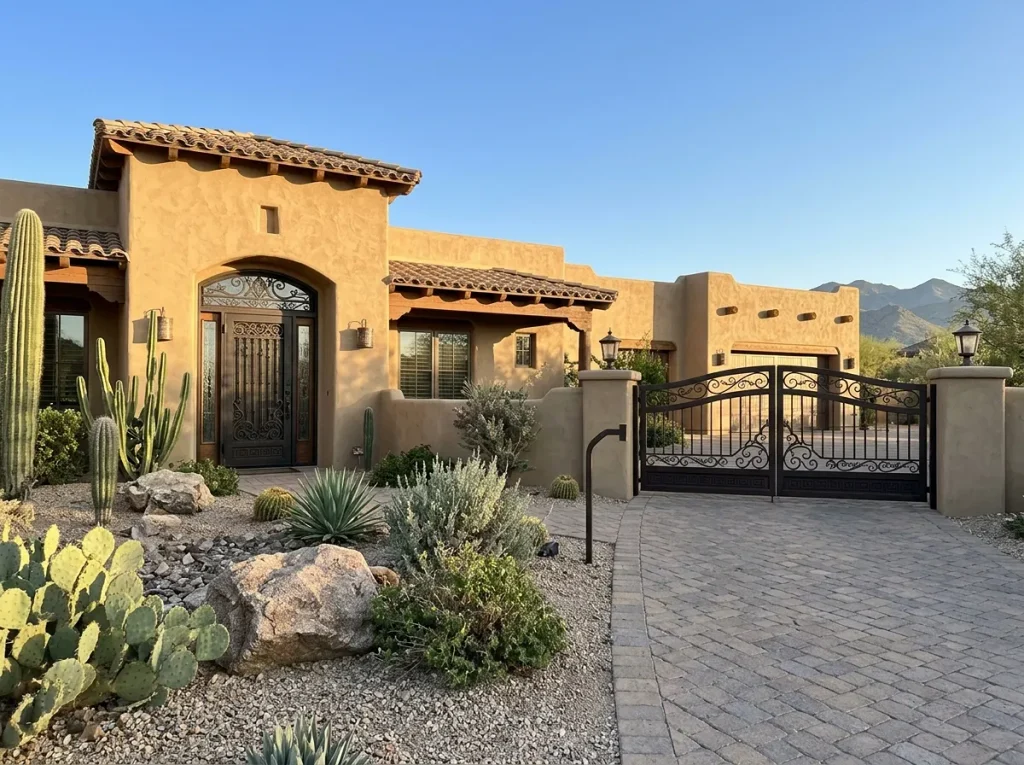
Table of Contents
Why Physical Barriers Still Matter
Security Doors: What Actually Makes One Secure
Security Gates: The Perimeter Layer
Locks, Openers, and Access Control
Installation: Why It Determines Everything
Real-World Conditions: The “If/Then” Guide
The Regrets Homeowners Mention Most
Key Takeaways / Quick Summary
- Security doors and gates are physical barriers—cameras and alarms detect, but they don’t stop entry
- Steel is the strongest door material, with the highest impact resistance against forced entry
- Multi-point locking systems secure a door at three or more points and are the most important hardware upgrade
- The frame and anchoring matter as much as the door—a strong door in a weak frame fails
- Gates need reinforced posts set in concrete; a heavy gate on a weak post is a lever waiting to fail
- Security doors typically run 400–2,000+ installed; gates vary widely with size and material
- Professional installation protects both performance and warranty coverage
- Most break-ins are opportunistic—visible, well-installed barriers are a genuine deterrent
Why Physical Barriers Still Matter
Home security technology has improved dramatically. Video doorbells, motion sensors, smart locks, and cloud-connected cameras are now affordable and widely installed.
So why do physical barriers still matter?
Because deterrence and delay are different from detection. A camera can tell you someone approached your door. An alarm can alert you that a door opened. But both operate after the decision to break in has already been made. A security door or gate operates on the decision itself—if the house looks like it will take too long and make too much noise, most opportunistic intruders move on.
Most residential burglaries are not sophisticated operations. They’re quick attempts that depend on an easy entry point. The goal of a security barrier isn’t to survive a Hollywood-style assault—it’s to make your home a worse target than the one down the street.
Security Doors: What Actually Makes One Secure
Not every door labeled “security” delivers real protection. Here’s what separates the two.
Material and Gauge
Steel is the standard for real security doors. The gauge matters enormously—lower numbers mean thicker steel. A door panel in 12- or 14-gauge steel resists cutting, prying, and impact far better than thin 18- or 20-gauge material.
Fiberglass offers good impact resistance and low maintenance, but steel remains the strongest choice for pure forced-entry resistance.
If you want a deeper look at why steel performs so well under impact, our guide to steel security door benefits covers the specifics—durability, energy performance, and how steel compares to other materials over time.
The Frame
This is where most security doors fail. A heavy steel door hung in a light frame anchored into stucco can be pried out of the wall as a unit. The frame must be reinforced and anchored into structural framing, not just the exterior cladding.
What to look for: A steel or reinforced frame, multiple anchor points, and fasteners long enough to reach the studs.
Locks and Hardware
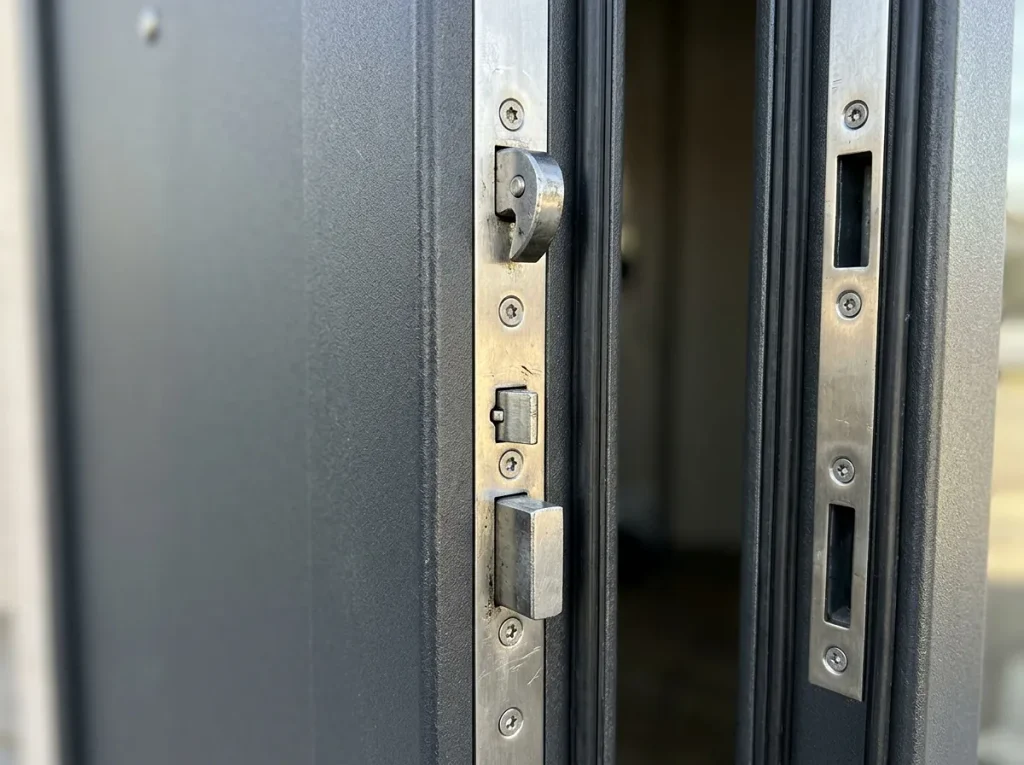
A single latch does not secure a door. Look for:
- Multi-point locking engaging at three or more points
- Grade 1 or Grade 2 deadbolts rated by the Builders Hardware Manufacturers Association (BHMA)
- Full-length throw bolts extending at least one inch into the frame
- Reinforced strike plates secured with long screws into framing
- Security hinges with non-removable pins
Glass
If the door has glass panels, standard annealed glass breaks easily. Laminated or impact-resistant glass stays in the frame after impact, preventing the quick “break and reach” entry.
Screens
A security screen door adds ventilation and visibility while maintaining a physical barrier. The screen material matters—heavy-duty stainless steel mesh resists cutting far better than standard fiberglass insect screen.
Wondering whether you need a solid door or a screen version? Our comparison of security door vs security screen door breaks down the trade-offs between ventilation, visibility, and maximum protection.
Security Gates: The Perimeter Layer
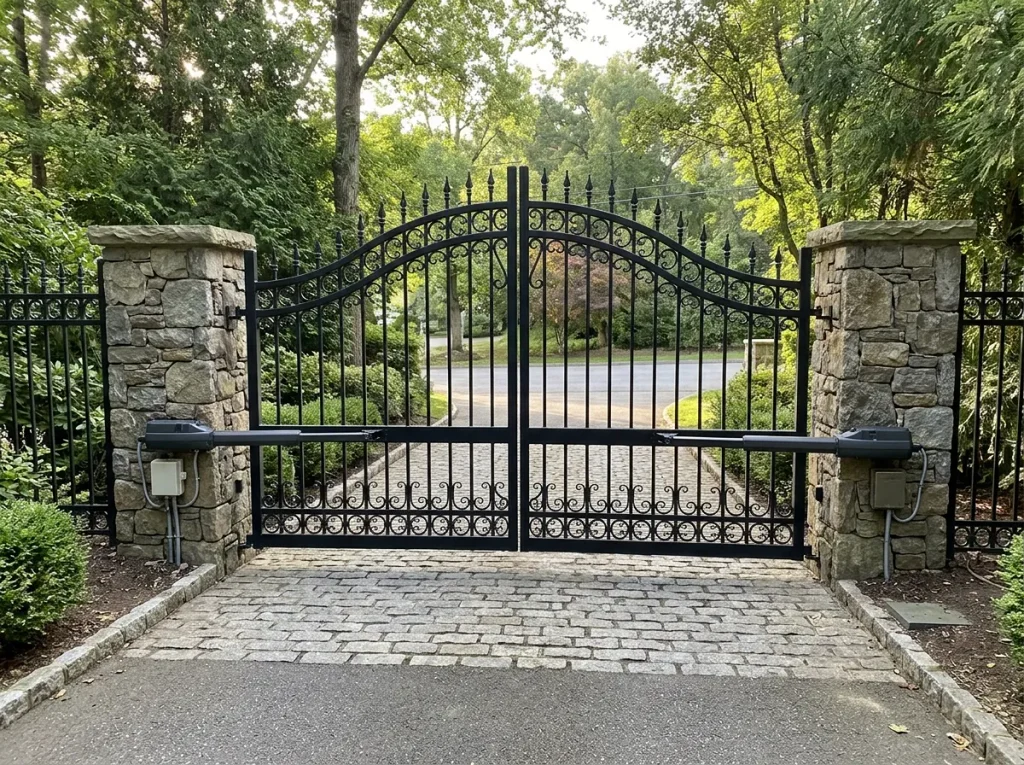
A gate protects a different part of the property—the driveway, side yard, or rear access point. It’s the barrier that controls whether a vehicle or a person gets past the perimeter at all.
Gate Types
| Gate Type | Typical Use | Best For |
| Driveway gate (swing) | Vehicle access | Wide openings, residential driveways |
| Driveway gate (sliding) | Vehicle access | Sloped ground, limited swing space |
| Pedestrian gate | Walk-through access | Side yards, pool areas, rear entries |
| Wrought iron / ornamental | Decorative perimeter | Visibility plus physical barrier |
| Steel plate / solid | Maximum privacy | Privacy-focused properties |
| Automatic gate | Convenience access | Frequent entry, integrated security |
The Post Is the Gate
Here’s the mistake that undermines more residential gates than any other: a heavy gate hung on an underbuilt post.
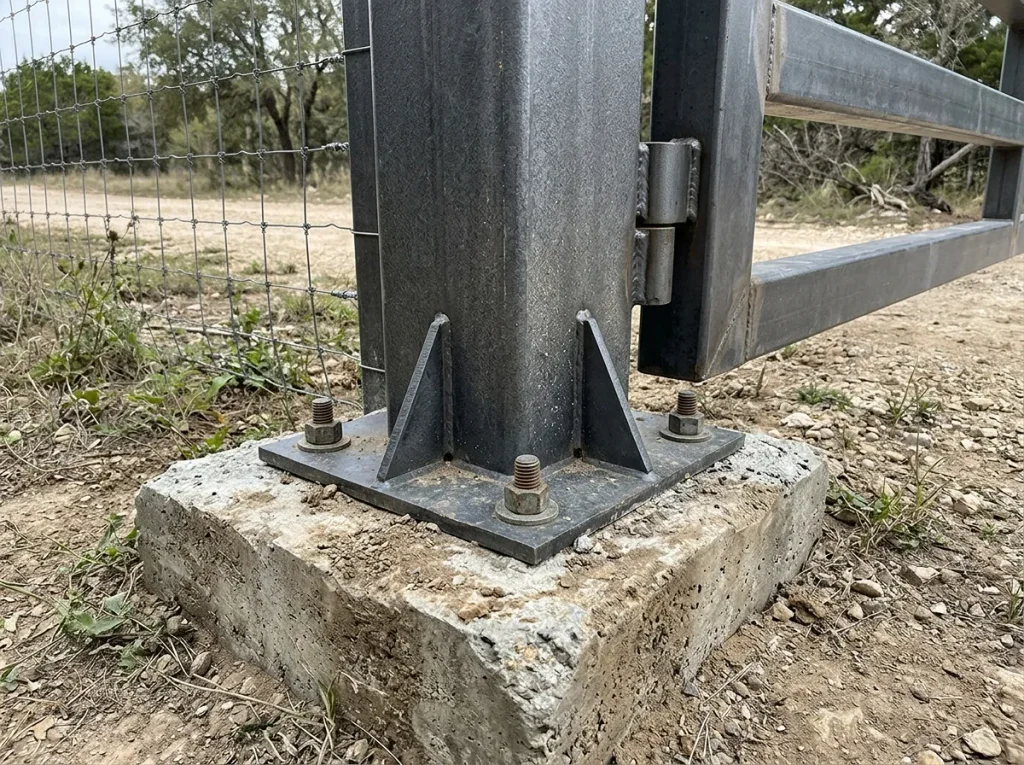
A gate is a lever. Every push on the far edge multiplies force at the hinge and post. If the post is a thin tube set shallowly in loose soil, that force eventually loosens it—and a loose gate can be lifted, pushed out of alignment, or forced.
What a proper gate post requires:
- Adequate post size for the gate’s weight and span
- Setting depth below frost line or to a depth appropriate for the soil
- Concrete setting, not surface mounting
- Proper hinge spacing so load is distributed
- A latch that engages securely and can’t be lifted from outside
Gate Hardware
- Self-closing hinges with tension adjustment
- Heavy-duty latches that engage a reinforced strike
- Anti-lift pins or caps on swing gates to prevent removal
- Lockable latches for pedestrian gates
- Automatic openers with safety sensors and battery backup
Materials Compared
| Material | Strength | Maintenance | Cost | Best For |
| Steel (solid) | Highest | Low | $$ | Maximum security, rear and side entries |
| Steel (decorative / wrought iron) | High | Low to moderate | $$$ | Driveway and pedestrian gates |
| Aluminum | Moderate | Very low | $$ | Light gates, corrosion resistance |
| Fiberglass door | High (doors) | Very low | $$$ | Doors where aesthetics matter |
| Wood | Moderate | High | $ to $$$ | Privacy, matching existing fencing |
| Chain link | Low | Very low | $ | Property boundaries, not security |
Arizona note: Powder-coated steel and aluminum hold up well to heat and UV. Wood gates require regular sealing in our climate—the sun and dry air crack and warp untreated wood quickly.
Locks, Openers, and Access Control
The barrier is only as good as the way it opens.
For doors:
- Multi-point locking with a Grade 1 or 2 deadbolt
- Smart locks with keypad or app access—convenient, and eliminates the hidden-key vulnerability
- Reinforced strike plates with long screws into framing
For gates:
- Heavy-duty keyed latches on pedestrian gates
- Automatic openers with safety sensors (required for vehicle gates to prevent injury)
- Battery backup so the gate still functions in a power outage
- Keypad or intercom entry for guest and delivery access
- Video intercom integration if the gate is out of sight from the house
A practical consideration: If your gate opener has no battery backup, a power outage leaves you either locked in or with a gate that’s been manually released. Confirm the manual release procedure and make sure everyone in the household knows it.
Installation: Why It Determines Everything
A premium door or gate installed poorly performs worse than a mid-range product installed correctly. This is the most consistent pattern in home security.
For doors, installation must include:
- Accurate measurement of the rough opening
- Anchoring into structural framing, not just stucco
- Proper flashing and waterproofing
- Level and square setting so locks engage correctly
- Low-expansion foam insulation and exterior sealing
For gates, installation must include:
- Posts set in concrete at adequate depth
- Proper hinge alignment for smooth operation
- Reinforced latch and strike
- Clearance for ground movement
- Correct opener installation with safety sensors
Arizona-specific: Stucco exteriors require cutting back to reach framing—a step inexperienced installers sometimes skip. That’s where water intrusion and anchoring failures begin.
Real-World Conditions: The “If/Then” Guide
If you’re starting from scratch → Then layer your defenses: secure doors first (they’re the most common entry point), then perimeter gates, then detection and monitoring.
If you have a rear or side door facing a yard → Then prioritize that door. It’s typically the least visible entry point and the most attractive to intruders.
If your gate is decorative but lightweight → Then it’s a visual boundary, not a security barrier. Strengthen the posts and hardware before relying on it.
If you have young children → Then avoid automatic gates without safety sensors, and choose door hardware that can’t be manipulated by small hands.
If you have a pool → Then a self-closing, self-latching pedestrian gate is often required by code and is genuinely valuable for safety.
If you’re in a rental → Then focus on renter-friendly door upgrades and ask the landlord about gate hardware.
If you want ventilation and visibility → Then a security screen door may suit you better than a solid door.
If you want maximum protection → Then choose a solid steel door with multi-point locking and laminated glass, and a steel gate with concrete-set posts.
If you have a long driveway → Then an automatic sliding gate with keypad access and battery backup is usually the practical choice.
If you’re preparing to sell → Then visible, well-installed security features read as care and quality to buyers.
The Regrets Homeowners Mention Most
Regret 1: Buying a “security” door that’s mostly cosmetic
Thin gauge steel and a single latch look like security but don’t perform like it. Ask about the gauge and locking system before you buy.
Regret 2: Underbuilding the gate post
The most common gate failure. A heavy gate on a shallow post works fine for two years, then sags and stops latching.
Regret 3: Anchoring a door into stucco only
A strong door in a weak frame can be pried out as a unit. Anchoring into framing is what makes the door matter.
Regret 4: Skipping the safety sensors on an automatic gate
Beyond the code requirement, an unmonitored automatic gate is a genuine injury risk to children and pets.
Regret 5: Neglecting maintenance on moving parts
Hinges, latches, and openers need lubrication and adjustment. A seized latch on a security gate can leave you locked out—or leave the gate unsecured.
Regret 6: Treating cameras as a substitute for barriers
Cameras are valuable, but they don’t stop entry. Barriers do.
Common Questions We Get Asked
What’s the difference between a security door and a regular door?
A security door is built from heavier-gauge steel with reinforced frames, multi-point locking, and often security glass. A standard door—even a solid wood one—is far easier to force.
Are security doors and gates worth the investment?
Yes, if you want physical protection rather than just detection. Cameras and alarms record events; doors and gates prevent them.
What’s the best material for a security door?
Steel, typically 12- or 14-gauge for the panel with a reinforced frame. See our guide to steel security door benefits for a detailed comparison.
Should I choose a security door or a security screen door?
A solid door offers maximum protection; a screen door offers ventilation and visibility with added security. Our comparison of security door vs security screen door explains the trade-offs.
How deep should a gate post be set?
Depends on gate weight, span, and soil. The critical point is that posts must be set in concrete at adequate depth—surface-mounted posts fail under load.
Do automatic gates need safety sensors?
Yes. Vehicle gates with openers require safety sensors to prevent injury, and battery backup is strongly recommended so the gate functions during power outages.
How much do security doors cost?
Typically 400–2,000+ installed, depending on material, size, design, and hardware.
How much do security gates cost?
Highly variable. Pedestrian gates are on the lower end; driveway gates with automatic openers and decorative steel run substantially higher.
Can I install a security door or gate myself?
We strongly recommend professional installation. Proper anchoring into framing and concrete-set posts are what make the barrier work—and most manufacturer warranties require professional installation.
Do security doors and gates improve energy efficiency?
Security doors add an insulating layer at the entry, and well-sealed doors reduce air infiltration. The primary benefit remains security, but there is an energy component.
Why Talk to Windowz4Less Arizona
Security doors and gates only work when the whole system is right: the material, the frame, the anchors, the locks, and the installation. A gap in any one of those turns a barrier into decoration.
Windowz4Less Arizona works with homeowners across Mesa, Phoenix, Scottsdale, Gilbert, Chandler, and the surrounding Valley communities. We install security doors and gates, know how to anchor properly into Arizona’s stucco construction, and can help you choose hardware that actually performs. We’ll give you a straight answer about what your property needs—and what it doesn’t.
Your Next Step
If you’re serious about protecting your home, start with the physical barriers. They’re the part of security that works even when the power is out, the Wi-Fi is down, and no one is watching a camera feed.
Contact Windowz4Less Arizona today for a free, no-obligation estimate. We’ll assess your entry points, recommend the right combination of security doors and gates for your property, and provide professional installation you can trust.